Hacking Biology at the Fund Longevity rally in Rome
Hacking Biology took part in the global Fund Longevity rally on 8 April 2026, at Largo di Torre Argentina in Rome — one of twenty cities asking governments to treat aging as the public-health priority it is.
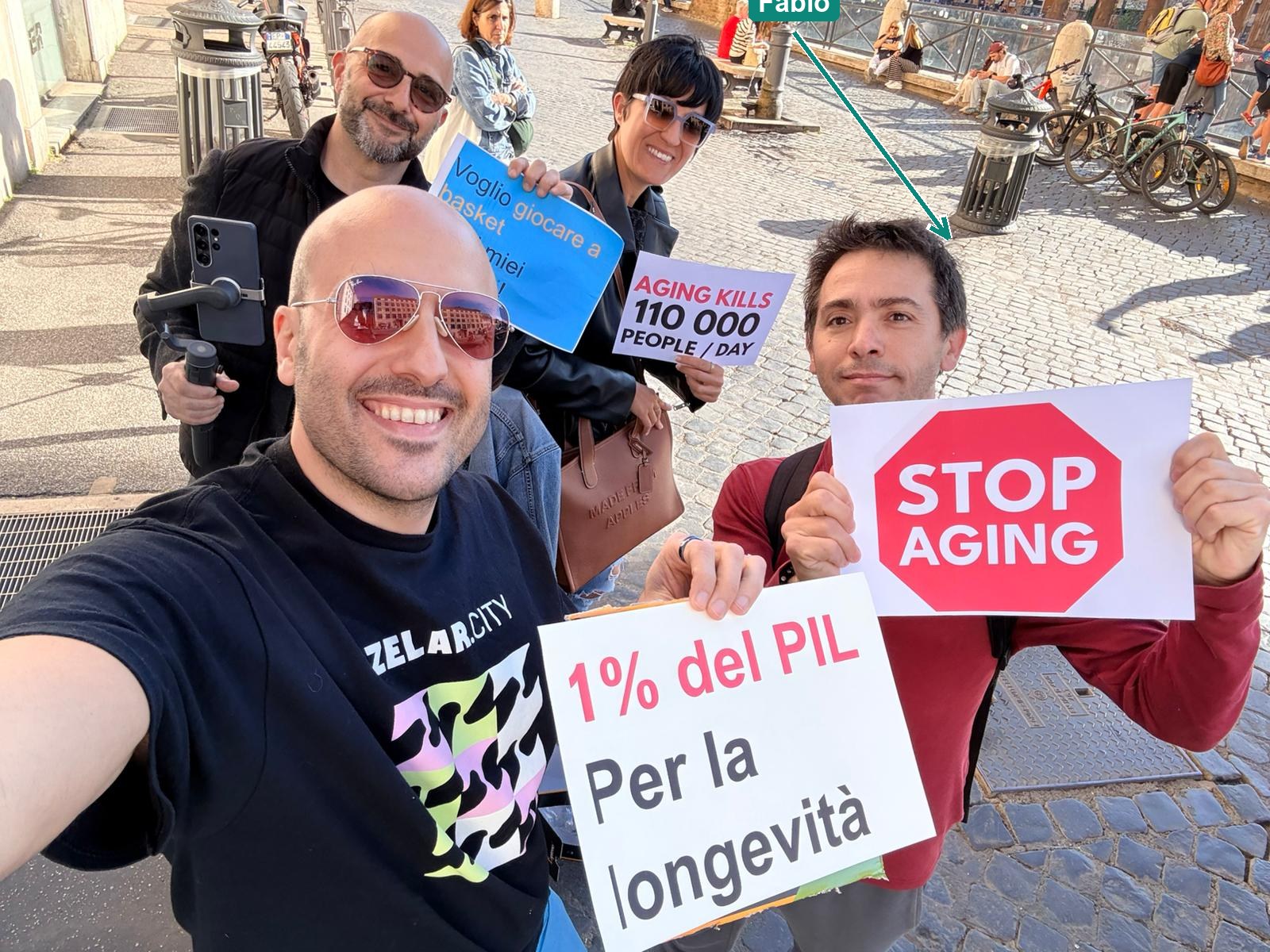
Hacking Biology took part in the Fund Longevity global rally on Wednesday 8 April 2026, in Rome, at Largo di Torre Argentina (Via San Nicola de’ Cesarini), 17:00–18:00 CEST. Rome was one of about twenty cities holding a simultaneous action — Amsterdam, Berlin, Brussels, London, Madrid, Paris, Prague, Stockholm, Tel Aviv, Toronto, San Francisco, Abu Dhabi and others — under one banner: fundlongevity.org .
The ask
The campaign’s starting figure is blunt. Aging kills around 110,000 people a day. It is the primary risk factor behind nearly every major non-infectious disease — cancer, cardiovascular disease, dementia — and beyond mortality it produces decades of frailty and lost independence. The campaign’s argument is that this is the largest source of human suffering that is still accepted as normal, and that it receives a fraction of the money spent on its symptoms.
What Fund Longevity asks for is not a slogan but a policy blueprint, the Longevity State: a National Longevity Strategy run by a cross-ministerial commission — Health, Education, Science, Economy, Labour — and funded with 1% of the yearly government budget. In Rome the sign for it read 1% del PIL per la longevità. Six pillars sit underneath:
- Talents — fast-tracked visas and credential recognition for researchers and clinicians, and programmes bridging aging biology, medicine and data science.
- Science — sustainable long-term funding for fundamental research on aging, and risk-proportionate regulation in place of blanket prohibitions.
- Translation — a dedicated longevity agency on ARPA/DARPA lines, adaptive licensing, regulatory sandboxes for combination and repurposed therapies, and publicly funded therapies priced for universal access.
- Healthcare — population-scale screening and prevention, and longitudinal biomarker collection as routine rather than exceptional.
- Data — open, interoperable data: secure free access to anonymised data for any researcher, unified interoperability standards, and standardised endpoints for gero-therapeutic trials.
- International — coordination across jurisdictions rather than twenty separate efforts.
Why we were there
The Data pillar is the one this Foundation exists to work on, from the other end.
Public policy can mandate that health data be interoperable and openly available to researchers. It cannot, on its own, produce the data that people generate about themselves — the protocols biohackers actually run, the biomarkers they actually measure, the outcomes they actually get. That record is being created right now, and almost all of it is disappearing into forum threads and private spreadsheets.
biohack.it exists to catch it in a structured, standard-shaped form, and the Foundation exists to guarantee it stays open and stays the person’s own. A national longevity strategy and an open community dataset are the same argument made from opposite directions: measurement should be public, comparable, and free to build on.
Standing in a square with a printed sign is a smaller thing than shipping the platform. But the funding gap the rally is about is precisely why so much of this work currently happens in the hands of individuals, at their own cost, on their own bodies — which is, in the end, what this blog documents.